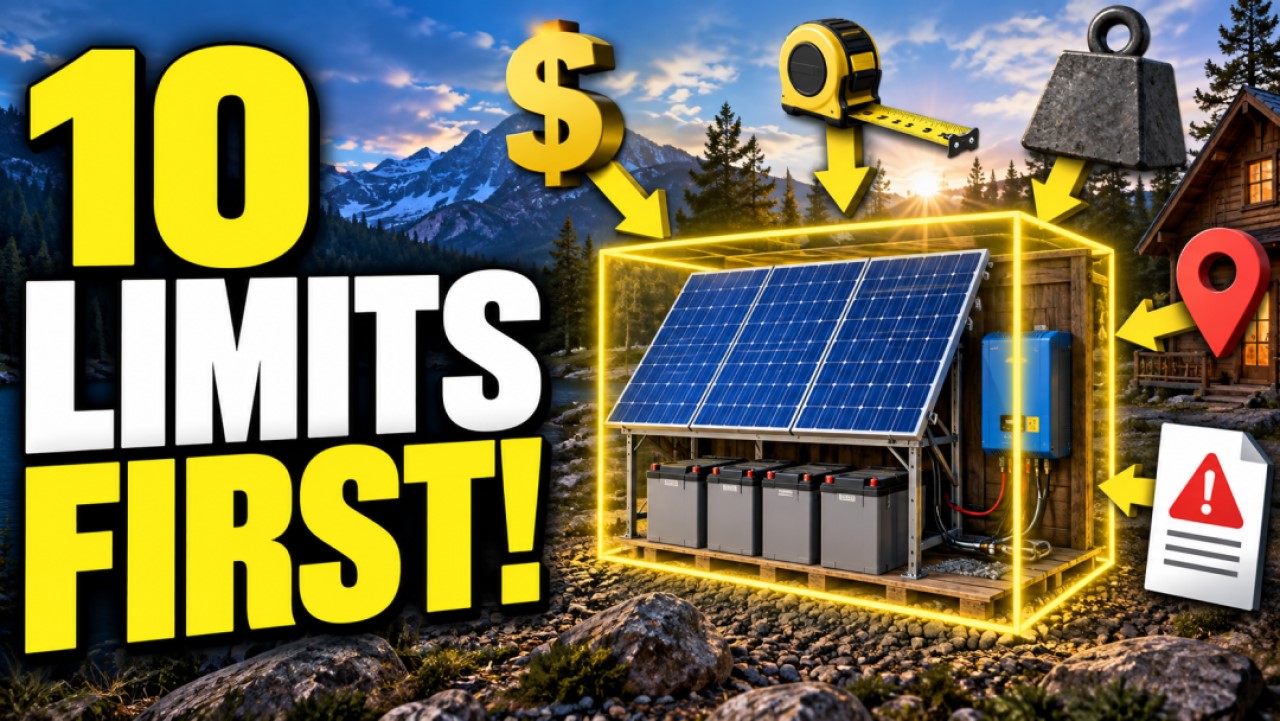
10 Solar System Design Limitations You Need to Know First
Designing a solar system would be easy if money, space and weight didn’t matter—and you could install panels anywhere you wanted.
That usually isn’t reality.
Before calculating how many solar panels you need, how much battery storage to buy or what size inverter to install, you need to identify the limitations you’re designing around. Those constraints can completely change what the right system looks like.
When I designed the solar system for our RV, I had limited roof space, limited equipment space and strict weight considerations. Now I’m designing a completely off-grid system for our cabin, and the limitations are almost the opposite. I have more physical space, but I already own a finite number of used solar panels with specific electrical characteristics.
Different project, different limitations—and a completely different design.
Watch the complete lesson below:
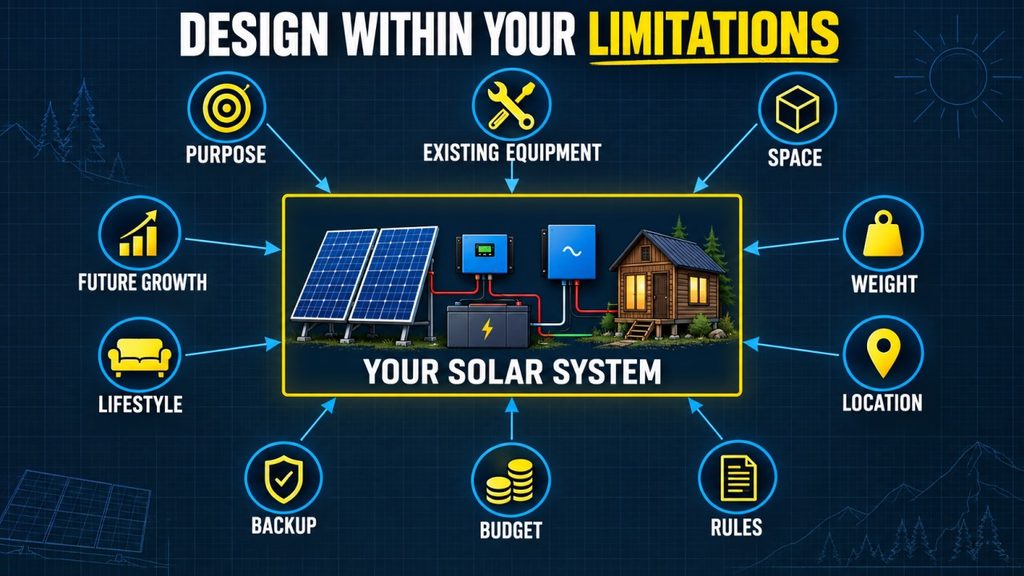
1. Start With the Job the Solar System Must Do
Saying, “I want to build a solar system,” doesn’t provide enough information to design one.
What is the system actually supposed to accomplish?
You might be building:
- A completely off-grid power system
- A grid-connected system that reduces your electric bill
- An emergency backup system
- A system that exports electricity to the utility
- A small experimental system for a shed, workshop or RV
- A system combining several of these purposes
These are very different design problems.
Our cabin will be completely off-grid. There isn’t a utility connection available as a safety net. If the system doesn’t generate enough electricity, we either reduce our consumption or run a generator.
Someone connected to the grid has another option: buy the difference from the utility. An emergency backup system might only need to operate a refrigerator, freezer, lights and a few outlets during an outage.
Before buying equipment, write down exactly what your system is expected to do. If you don’t know the job, you can’t properly design the tool.
2. Equipment You Already Own
Starting from scratch provides the most design freedom, but many solar projects don’t begin that way.
You may already own:
- Solar panels
- Batteries
- An inverter
- A charge controller
- A generator
- Part of an existing solar system
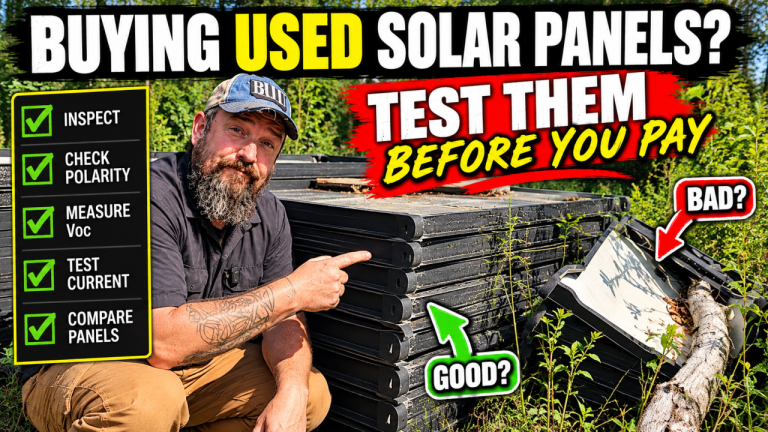
I purchased the used 327-watt SunPower panels for our cabin before completing the final system design. Some were later damaged when a tree fell on them during an ice storm.
Once I finish testing them, the number of good panels I have becomes one of my design constraints. I can’t calculate that the perfect system requires 47 panels and expect 47 matching panels to magically appear.
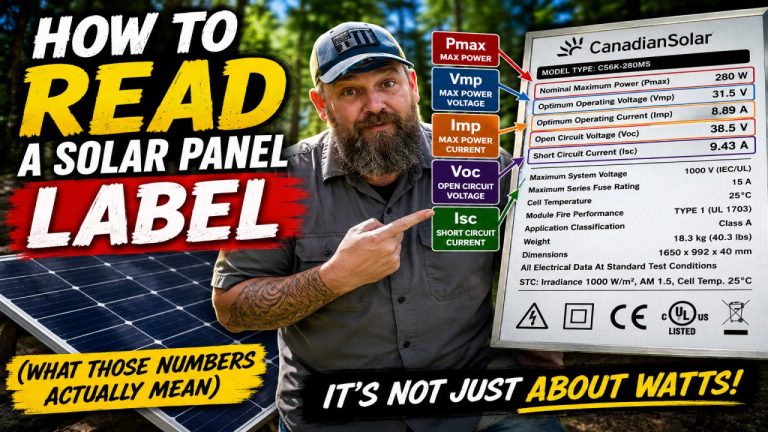
Existing equipment affects more than total wattage. Solar panels have specific voltage and current ratings. Those specifications—and how the panels are wired—determine what inverters or charge controllers can work with the array.
There is nothing wrong with designing around equipment you already own, especially when you got a good deal. You simply need to recognize that every component you keep creates compatibility requirements for the rest of the system.
3. Available Installation Space
A system that looks perfect on paper is useless if it doesn’t physically fit.
Roof-mounted systems must work around:
- Roof edges
- Vents
- Air conditioners
- Chimneys
- Plumbing penetrations
- Shaded areas
- Required access and setbacks
Panel dimensions can be just as important as panel wattage. Two panels might produce similar power, but one may fit the available area much better.
Equipment also needs space. Batteries, inverters, charge controllers, disconnects, breakers and wiring all require suitable locations. You also need enough access to safely install, inspect and service everything.
Measure your available space before choosing equipment.
4. Weight and Structural Limitations
Weight was a major consideration when I designed our RV solar system.
Every panel, battery, inverter and and piece of mounting hardware added weight to an RV that already had a maximum allowable capacity. I couldn’t continue adding batteries simply because more storage sounded useful.
Weight can also matter in a house, cabin, shed or workshop.
Ask yourself:
- Can the roof support the panels and racking?
- Can the wall support a wall-mounted battery?
- Can the floor support the complete battery bank?
- Can the equipment be safely moved into position?
Some large batteries weigh several hundred pounds. When weight or structural capacity becomes a problem, it can create a hard limit on the design.
5. Solar Panel Location
Owning five acres does not necessarily mean you have five acres of good solar-panel locations.
A suitable location depends on more than open space. You need to consider:
- Sun exposure
- Trees and seasonal shading
- Buildings
- Terrain
- Panel orientation
- Mounting angle
- Maintenance access
- Future projects
- Distance from the other system components
Distance matters because moving electricity through wire creates voltage drop. Longer distances can require larger and more expensive wire.
The sunniest location on the property isn’t automatically the best location. It must work with the rest of the system.
6. Your Actual Budget
Almost everyone designing a solar system has a budget.
You could design an incredible system with several days of battery storage, enough solar generation for poor winter conditions and enough inverter capacity to operate every load simultaneously. That doesn’t help if the system costs $25,000 and your budget is $10,000.
Remember that the major equipment isn’t the complete cost. Your budget also needs to include:
- Mounting and racking
- Wire and connectors
- Breakers and fuses
- Disconnects
- Combiner boxes
- Enclosures and battery racks
- Grounding equipment
- Installation tools and materials
A limited budget creates compromises. You might reduce your loads, accept occasional generator use, start with fewer batteries or build a system designed for later expansion.
There isn’t one correct compromise, but pretending the budget doesn’t exist isn’t a solution.
7. Codes, Permits and Utility Requirements
Some design limitations are imposed by someone else.
Depending on your location and the type of system, you may encounter:
- Electrical-code requirements
- Building permits
- Inspections
- HOA restrictions
- Utility interconnection agreements
- Export limits
- Approved-equipment requirements
Grid-connected systems usually have utility requirements that aren’t optional.
Our cabin system will be completely off-grid in a rural area. Don’t assume the rules affecting our project also apply to yours. Determine what is required where your system will actually be installed before spending thousands of dollars on equipment.
8. Your Backup-Power Plan
What happens when your solar system can’t provide the electricity you want?
Possible backup strategies include:
- A generator
- The electrical grid
- A smaller group of critical loads
- Temporarily reducing energy consumption
- Additional battery autonomy
Someone willing to run a generator after two cloudy days may need less battery storage than someone who wants five days of autonomy.
We plan to have a generator at the cabin, but I consider it strictly backup. I don’t want to intentionally undersize the solar system and depend on the generator during normal daily operation.
Your goal may be different. The important thing is to include backup power in the original design instead of treating it as an afterthought.
9. What You’re Willing to Change
Sometimes the limitation isn’t the solar equipment. It’s what we’re asking the system to do.
If the system required to operate every desired load is outside your budget, you have two basic options:
- Spend more money.
- Change how you use electricity.
That could mean:
- Avoiding several large loads at the same time
- Switching an electric appliance to propane or another fuel
- Waiting to do laundry until the air conditioner or other major load is off
- Operating large loads during peak solar-production hours
- Eliminating unnecessary loads
Living off-grid in our RV taught us that energy management can become part of your lifestyle.
You can spend enough money to build a system that rarely requires you to think about consumption, or you can understand the system and adjust when and how you use electricity. Neither approach is automatically wrong, but the decision affects the system’s size and cost.
10. Future Expansion
Will the system ever need to grow?
Today’s small cabin could gain a workshop in a few years. You might add another freezer, air conditioning, an electric vehicle or other major loads. You might also start with a small battery bank and expand it later.
Some solar-system components are relatively easy to expand. Others are expensive to replace.
Planning for future growth doesn’t mean buying everything today. It means avoiding decisions that unnecessarily trap you inside a system that can’t grow with your needs.
My RV and Cabin Have Different Design Boxes
The RV system was primarily limited by:
- Finite roof space
- Equipment and battery locations
- Total added weight
The cabin system has another set of boundaries:
- A finite number of existing solar panels
- The voltage, current and wattage of those panels
- Their physical dimensions
- The available installation area
- Our budget
- Completely off-grid operation
- Generator backup
- The loads we expect to operate
Those constraints form the walls of my design box. Now I can begin designing inside it.
Your box will probably look completely different—and that is the point.
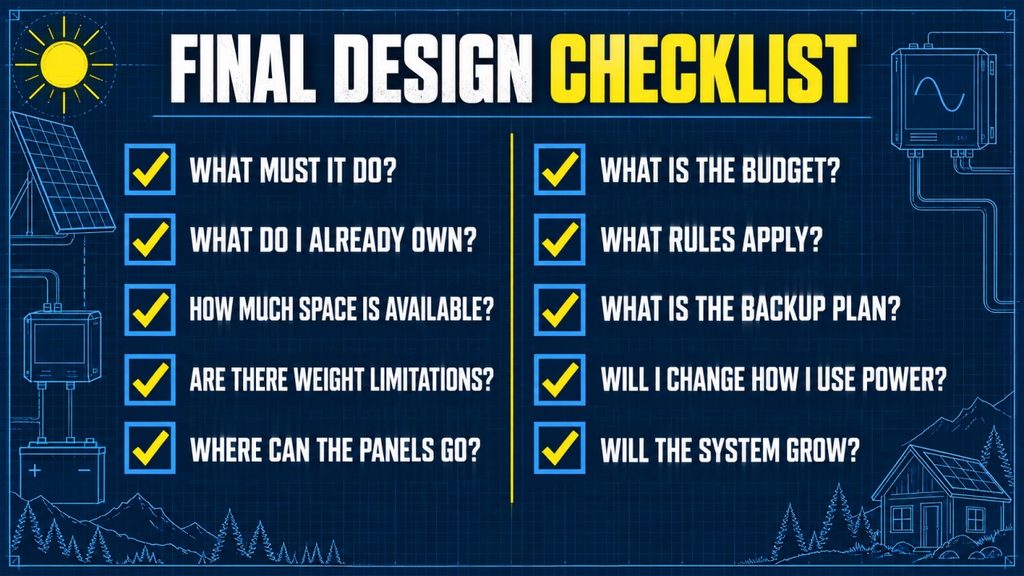
Final Solar Design Checklist
Before sizing your system, answer these questions:
- What must the system do?
- What equipment do I already own?
- How much physical space is available?
- Are there weight or structural limitations?
- Where can the solar panels go?
- What is the actual budget?
- What codes, permits or utility rules apply?
- What is the backup-power plan?
- Am I willing to change how or when I use electricity?
- Will the system need to grow?
You don’t need every answer to be perfect yet. You need to identify which answers will place boundaries around your design.
Next: Sizing the Solar System
Once the limitations are understood, we can start doing the math.
In the next lesson, we’ll identify the loads we want to operate, determine how much power they require at one time and calculate how much energy they consume. From there, we can begin sizing the inverter, battery storage and solar array.
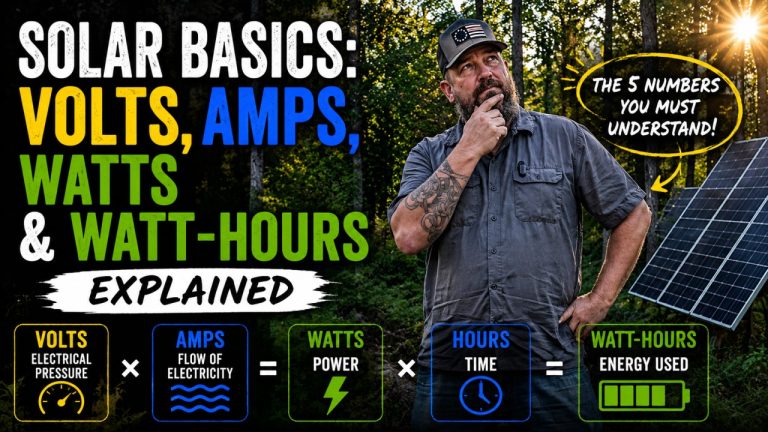
This is where watts and watt-hours stop being vocabulary terms and become essential design tools.
Need help keeping the electrical fundamentals straight? Download my free Off-Grid Solar Quick Reference: The LOTS Project Solar Hub