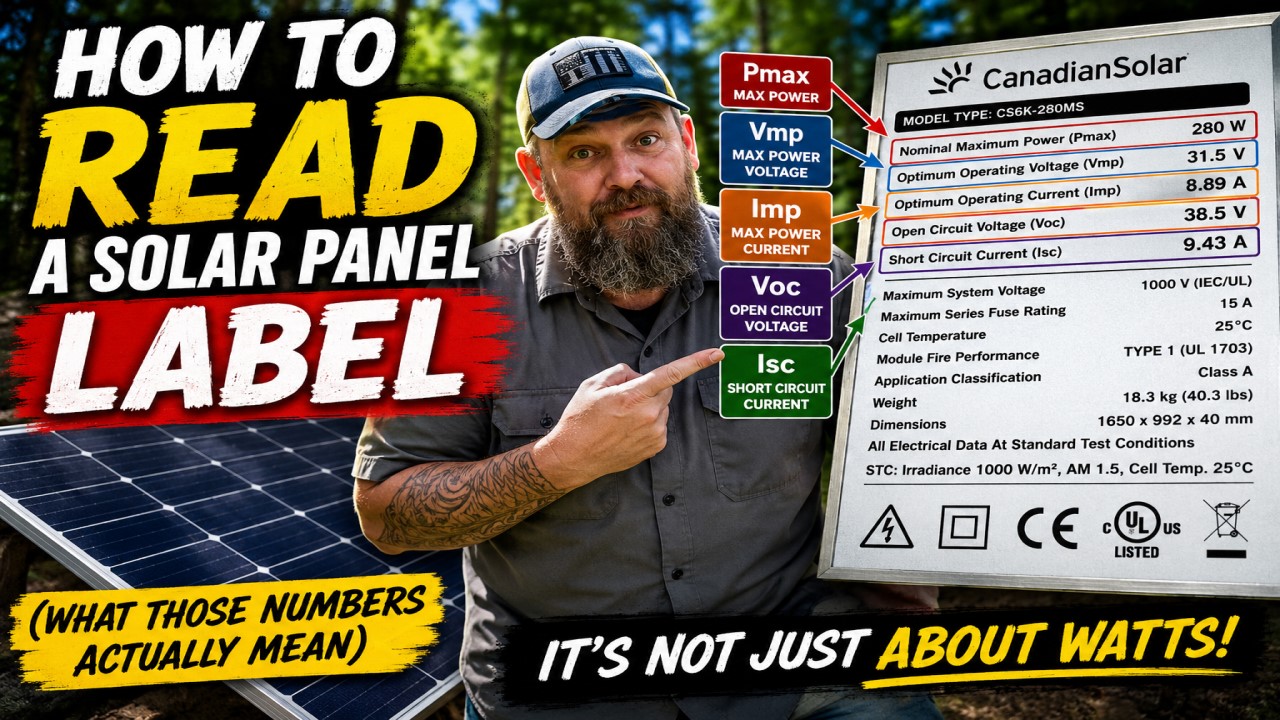
How to Read a Solar Panel Label (What Those Numbers Actually Mean)
If you’re shopping for solar panels, the first number you’ll probably look at is the wattage.
One hundred watts. Two hundred watts. Four hundred watts. Maybe even more.
Wattage is useful, but it only tells you part of the story. Two panels with similar wattage ratings can have very different operating voltages and currents. Those differences become extremely important when connecting multiple panels or matching an array to a charge controller, inverter or all-in-one system.
Fortunately, the information you need is already printed on the label attached to the back of the panel.
In this guide, we’ll break down the five most important solar-panel specifications, compare several real panels and explain which other label numbers you should recognize.
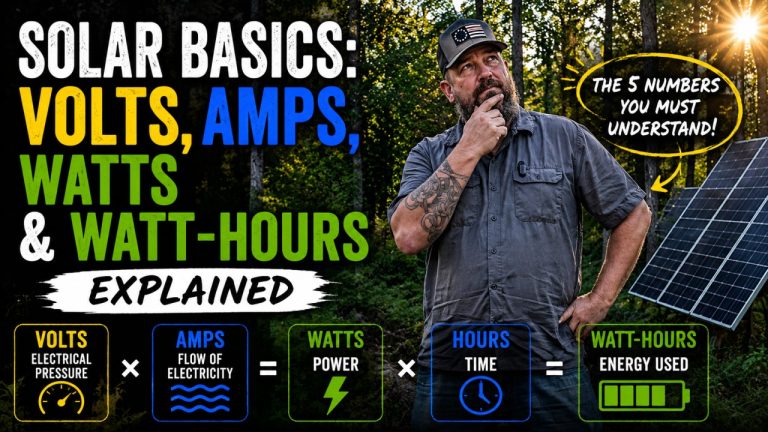
If volts, amps and watts are still unfamiliar, start with the previous lesson:
Previous lesson: Solar Basics: Volts, Amps, Watts & Watt-Hours Explained
The Five Most Important Solar Panel Numbers
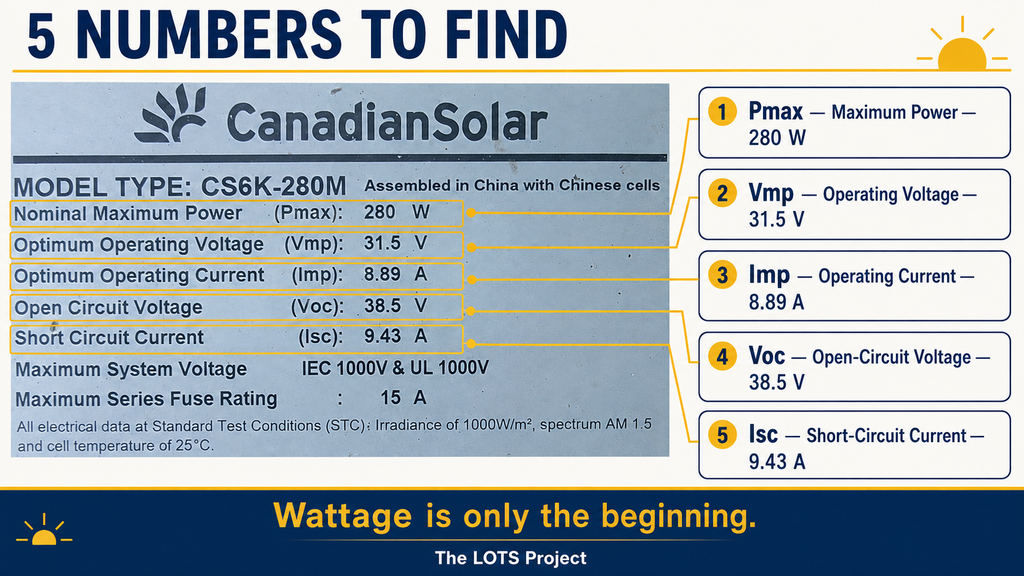
Most solar-panel labels contain model information, certifications, warnings and several electrical specifications. The five numbers I look for first are:
| Specification | Meaning | Why it matters |
|---|---|---|
| Pmax | Maximum power | The panel’s rated wattage under standard test conditions |
| Vmp | Voltage at maximum power | Approximate operating voltage near maximum output |
| Imp | Current at maximum power | Approximate operating current near maximum output |
| Voc | Open-circuit voltage | Panel voltage when no load is connected |
| Isc | Short-circuit current | Current produced under short-circuit test conditions |
Different manufacturers may capitalize or format the abbreviations differently, but the measurements mean the same things.
What Is Pmax?
Pmax stands for maximum power. It is the wattage number normally used to advertise and identify the panel.
A 280-watt panel has a Pmax of 280 watts.
That doesn’t mean the panel will continuously produce 280 watts whenever the sun is shining. Pmax is measured under standardized laboratory conditions so panels from different manufacturers can be compared on reasonably equal terms.
These are normally called Standard Test Conditions, or STC. They include:
- Solar irradiance of 1,000 watts per square meter
- A solar-cell temperature of 25°C
- A standardized solar spectrum, commonly listed as Air Mass 1.5
Notice that the specification uses cell temperature, not outside air temperature. A panel sitting in direct sunlight can become considerably hotter than the surrounding air.
Real-world output is affected by:
- Panel temperature
- Sun angle
- Clouds
- Shading
- Dirt and debris
- Wiring losses
- Equipment losses
- The panel’s condition
Treat Pmax as the panel’s rated maximum power under controlled conditions—not a promise that you’ll see that output all day.
Vmp and Imp: Where the Wattage Comes From
The next two numbers work together.
Vmp means voltage at maximum power.
Imp means current at maximum power.
These describe the voltage and current near the panel’s maximum-power operating point. Multiplying them gives us approximately the panel’s rated wattage:
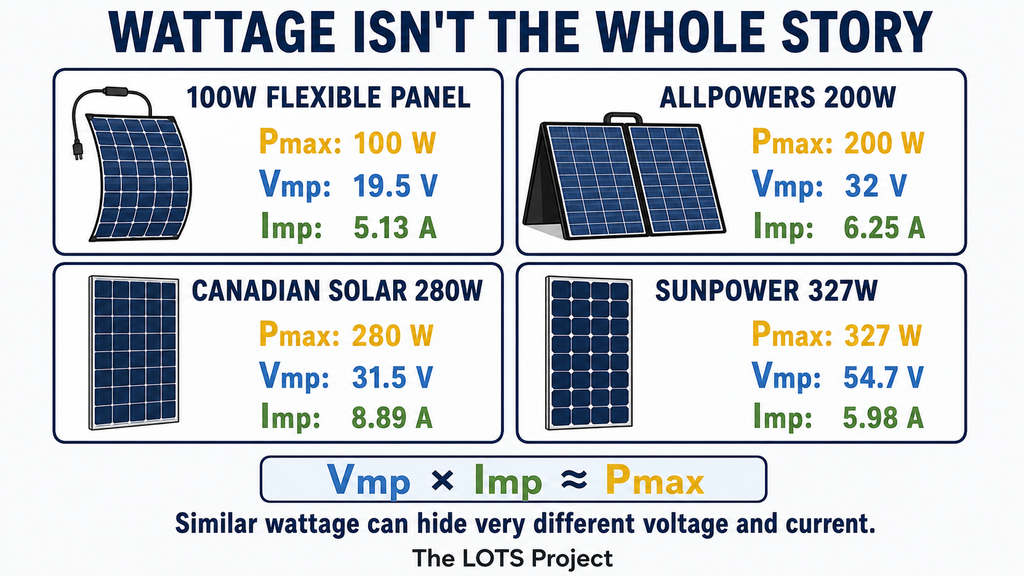
Vmp × Imp ≈ Pmax
Canadian Solar 280-Watt Panel
The Canadian Solar panel shown in the video lists:
- Vmp: 31.5 volts
- Imp: 8.89 amps
The calculation is:
31.5V × 8.89A = 280.035W
That gives us approximately 280 watts.
SunPower 327-Watt Panel
The SunPower panel lists:
- Vmp: 54.7 volts
- Imp: 5.98 amps
The calculation is:
54.7V × 5.98A = 327.106W
That gives us approximately 327 watts.
These panels are only 47 watts apart, but their electrical characteristics are significantly different.
The SunPower panel operates at a much higher voltage while producing considerably less current than the Canadian Solar panel.
That is why wattage alone doesn’t describe the electrical makeup of a solar panel.
Comparing Four Different Solar Panels
Here are the four panels used in the video:
| Panel | Pmax | Vmp | Imp |
|---|---|---|---|
| Flexible panel | 100W | 19.5V | 5.13A |
| ALLPOWERS flexible panel | 200W | 32V | 6.25A |
| Canadian Solar panel | 280W | 31.5V | 8.89A |
| SunPower panel | 327W | 54.7V | 5.98A |
Notice that the 200-watt ALLPOWERS panel and the 280-watt Canadian Solar panel have almost identical operating voltages:
- ALLPOWERS: 32V
- Canadian Solar: 31.5V
Their operating currents are very different:
- ALLPOWERS: 6.25A
- Canadian Solar: 8.89A
That difference in current explains the difference in wattage.
The smaller 100-watt flexible panel has a Vmp of 19.5 volts and an Imp of 5.13 amps:
19.5V × 5.13A = 100.035W
Four panels can produce four different wattages using very different combinations of voltage and current.
Why Vmp and Imp Matter
One solar panel by itself is fairly simple. Things become more complicated when multiple panels are connected.
Panels can be wired:
- In series
- In parallel
- In a series-parallel combination
The way they are connected changes the array’s total voltage and current.
Your charge controller, inverter or all-in-one unit will have limits on the amount of voltage and current its solar input can accept. The individual panel specifications are the starting point for calculating whether a proposed array will remain inside those limits.
This is also why you shouldn’t assume two panels are compatible merely because they have similar wattage ratings.
What Is Voc?
Voc stands for open-circuit voltage.
This is the panel’s voltage when it is exposed to light but not connected to a load. Because no current is being drawn from the panel, its open-circuit voltage is higher than its maximum-power operating voltage.
The Canadian Solar panel lists:
- Vmp: 31.5V
- Voc: 38.5V
The SunPower panel lists:
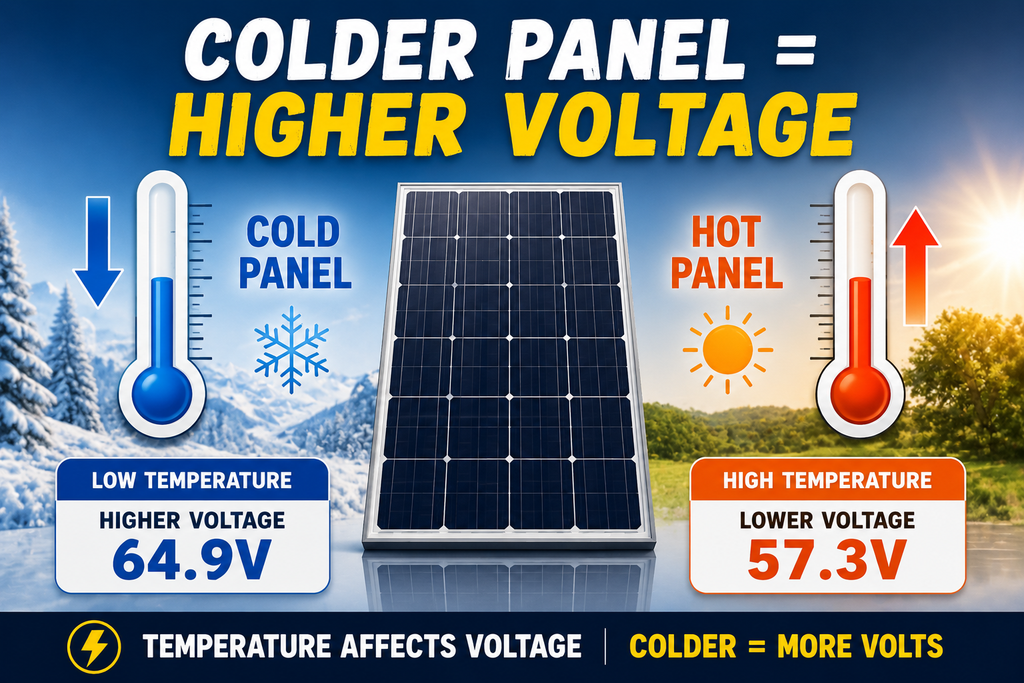
- Vmp: 54.7V
- Voc: 64.9V
Vmp and Voc describe different operating conditions and shouldn’t be confused.
Voc becomes critically important when panels are connected in series because their voltages add together. The charge controller or inverter connected to the array will have a maximum allowable solar-input voltage.
Exceeding that limit can damage the equipment.
Cold Panels Can Produce Higher Voltage
Solar-panel voltage changes with temperature. Colder panels can produce a higher voltage than the Voc printed on the label at Standard Test Conditions.
That means you cannot simply multiply the label’s Voc by the number of panels in a series string and assume you’re finished. The design must include enough margin for the lowest temperatures the array could realistically experience.
We’ll perform that calculation when we design the panel strings and match them to the inverter or charge controller.
For now, remember:
Voc is the number used when checking the array against the equipment’s maximum solar-input voltage—and cold-weather voltage must also be considered.
What Is Isc?
Isc stands for short-circuit current.
It represents the current a panel produces under short-circuit test conditions. Like Voc, Isc is normally higher than its maximum-power counterpart.
The Canadian Solar panel lists:
- Imp: 8.89A
- Isc: 9.43A
The SunPower panel lists:
- Imp: 5.98A
- Isc: 6.46A
Imp describes current near the maximum-power operating point. Isc describes short-circuit current under the specified test conditions.
Isc becomes important when designing conductors, overcurrent protection and other parts of the system. Additional design and safety factors may also apply, so don’t assume the printed Isc is automatically the final wire or fuse calculation.
We’ll cover wire sizing, breakers, fuses and disconnects separately later in the series.
Other Information on a Solar Panel Label
Pmax, Vmp, Imp, Voc and Isc are the five specifications beginners should learn first, but they aren’t the only useful information printed on the label.
Maximum System Voltage
Maximum system voltage tells you the highest system voltage for which the panel is designed and rated.
The Canadian Solar and SunPower panels shown in the video both list a maximum system voltage of 1,000 volts. The smaller ALLPOWERS flexible panel lists 120 volts.
That doesn’t mean the ALLPOWERS panel produces 120 volts. Its Vmp is approximately 32 volts.
The 120-volt specification is a system-rating limitation, not the panel’s normal output voltage.
Maximum Series Fuse Rating
The label may also list a maximum series fuse rating.
The Canadian Solar panel lists 15 amps, while the SunPower panel lists 20 amps.
This value does not automatically tell you which fuse to install. It identifies the maximum series-fuse rating permitted for that module. Proper overcurrent protection depends on the array configuration and the rest of the system design.
Temperature Coefficients
Many labels or manufacturer data sheets include temperature coefficients. These tell you how the panel’s voltage, current and power change as its temperature changes.
The Voc temperature coefficient becomes especially important when calculating the maximum cold-weather voltage of a series string.
Model and Certification Information
Labels also commonly include:
- Manufacturer and model number
- Serial number
- Safety certifications
- Fire rating
- Application class
- Warning information
- Manufacturing location or date
This information can help locate the panel’s full data sheet, especially when evaluating used panels.
How to Check Specifications Before Buying
You don’t need to physically purchase a panel and flip it over before finding its specifications.
Reputable manufacturers and sellers should provide the information through:
- Product specifications
- Manufacturer data sheets
- Installation manuals
- Downloadable technical documents
- Photographs of the panel label
Before buying a new or used panel, find:
- Pmax
- Vmp
- Imp
- Voc
- Isc
If a seller only provides the wattage and can’t produce a label photo, model number or data sheet, you don’t have enough information to properly design around that panel.
This is especially important when buying used panels locally. Ask for a clear photograph of the complete label before making the trip.
Panels and Equipment Mentioned in the Video
Disclosure: The following may include affiliate links. If you purchase something through one of these links, I may earn a commission at no additional cost to you.
You don’t need to purchase through these links to use the information in this guide. Whether you’re buying online, shopping locally or working with panels you already own, the same five specifications apply.
Solar Panel Label FAQ
Which voltage number should I use for a solar panel?
It depends on what you’re calculating. Vmp represents voltage near the panel’s maximum-power operating point. Voc represents voltage when no load is connected and is used when checking maximum array voltage.
Can two panels with the same wattage have different voltage and current?
Yes. Two panels can have the same or similar Pmax while using very different combinations of Vmp and Imp.
Can I connect panels with different specifications?
Sometimes, but mismatched voltage or current can reduce output or create design complications. The effect depends on whether the panels are connected in series, parallel or through separate charge-controller inputs.
Why is Voc higher than Vmp?
Voc is measured with no load connected. Vmp is measured near the panel’s maximum-power operating point while the panel is delivering current.
Does maximum system voltage mean panel output?
No. Maximum system voltage is a rating for the system in which the panel can be used. It is not the panel’s normal operating voltage.
The Five-Number Label Check
Whenever you inspect a solar-panel label or data sheet, begin with:
- Pmax: Rated maximum power under Standard Test Conditions
- Vmp: Voltage near maximum power
- Imp: Current near maximum power
- Voc: Open-circuit voltage
- Isc: Short-circuit current
You don’t need to memorize every certification or specification printed on the label. You need to recognize these numbers, understand what they describe and know where to find them when designing the system.
Once you understand them, the label stops looking like electrical gibberish.
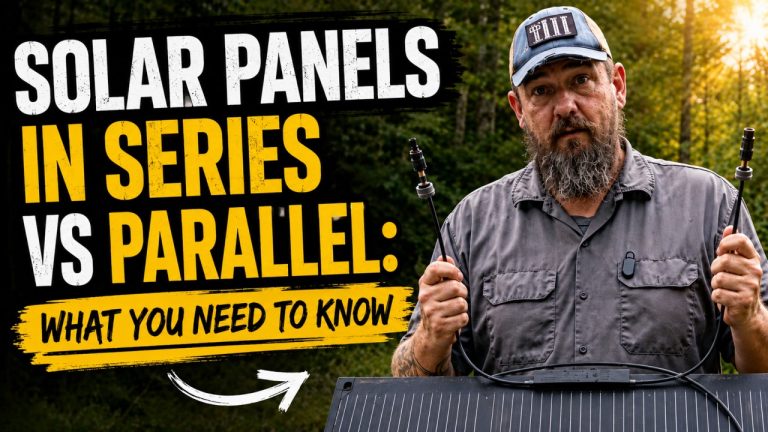
The next step is learning what happens when multiple panels are connected. We’ll use these same numbers to explain series wiring, parallel wiring and combinations of the two.
Next lesson: Solar Panels in Series vs. Parallel

3 Comments