Solar Basics: Volts, Amps, Watts & Watt-Hours Explained
Trying to design a solar system gets confusing quickly. Before long, you’re looking at volts, amps, watts, watt-hours, kilowatt-hours and amp-hours—and most explanations assume you already understand what all those numbers mean.
You don’t need to become an electrical engineer to build a practical solar system. You do, however, need to understand a few basic measurements before you can compare equipment, estimate your energy needs or determine whether different components will work together.
This guide explains the numbers in plain English and shows how they apply when designing a real solar system.
Solar Electrical Terms: The Quick Version
| Term | What it measures | Practical question it answers |
|---|---|---|
| Volts | Electrical potential or “pressure” | What voltage does the equipment operate at? |
| Amps | Electrical current or “flow” | How much current is moving through the circuit? |
| Watts | Power at a particular moment | How much power is being produced or consumed right now? |
| Watt-hours | Energy produced or consumed over time | How much total energy was used? |
| Kilowatt-hours | 1,000 watt-hours | How much energy does a house, battery or solar system use or store? |
| Amp-hours | Battery capacity at a particular voltage | How much charge does the battery hold? |
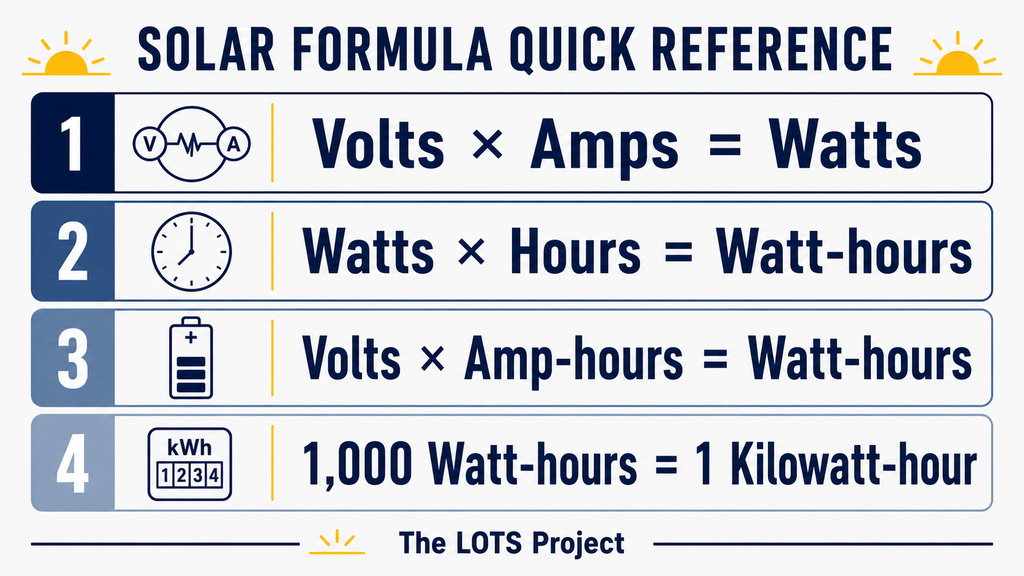
The three formulas we’ll use most often are:
Volts × Amps = Watts
Watts × Hours = Watt-hours
Volts × Amp-hours = Watt-hours
If you understand those relationships, most solar specifications begin making considerably more sense.
What Are Watts?
A watt is a measurement of power. Watts tell us how much power something is producing or consuming at a particular moment.
A solar panel rated at 400 watts can produce up to 400 watts under its specified test conditions. That doesn’t mean it will produce 400 watts continuously throughout the day. Its actual output will be affected by:
- Sunlight intensity
- Clouds
- Panel temperature
- Angle and orientation
- Shading
- Wiring and equipment losses
- The condition of the panel
The watt rating still gives us a convenient way to compare panels and estimate their potential output.
We also use watts when discussing electrical loads. As rough examples:
- A small LED light might consume approximately 10 watts.
- A laptop might use 100 to 150 watts.
- A microwave might draw 1,000 watts or more.
- An electric space heater commonly draws around 1,500 watts.
- An air conditioner may draw considerably more, depending on its size and operating conditions.
Watts tell us the rate at which power is being produced or consumed, but they don’t tell us how much total energy was used. For that, we need watt-hours.
Watts Versus Watt-Hours
Watts measure power at a particular moment.
Watt-hours measure energy over a period of time.
Suppose we run a 1,500-watt electric space heater for one hour:
1,500 watts × 1 hour = 1,500 watt-hours
That equals:
1,500 watt-hours = 1.5 kilowatt-hours
If we run that same heater for four hours:
1,500 watts × 4 hours = 6,000 watt-hours
That equals 6 kilowatt-hours.
The heater still draws 1,500 watts while operating. The difference is how long it runs.
One thousand watt-hours equals one kilowatt-hour:
1,000 Wh = 1 kWh
Kilowatt-hours are the units used on a normal electric bill. When you live off-grid, the same measurement becomes even more important because you have to produce and store those kilowatt-hours yourself.
During a sunny day, energy may come directly from the solar array. At night, it will normally come from the batteries. During extended poor weather, a generator or another energy source may need to cover the difference.
This is why knowing that someone has an 8-kilowatt solar array doesn’t automatically tell us whether the system is large enough. We also need to know:
- How many kilowatt-hours the loads consume
- When that energy is consumed
- How much energy the panels can realistically produce
- How much energy the batteries can store
- How many cloudy days the system needs to handle
Kilowatts describe power. Kilowatt-hours describe energy over time.
Confusing those two measurements is one of the most common mistakes in solar discussions.
What Are Volts and Amps?
Volts are commonly described as electrical pressure, while amps are described as electrical flow.
That isn’t a complete electrical-theory explanation, but it is useful when you’re beginning to understand solar equipment.
The important relationship is:
Volts × Amps = Watts
For example:
12 volts × 100 amps = 1,200 watts
Now compare that with a higher-voltage system:
48 volts × 25 amps = 1,200 watts
Both examples deliver the same amount of power, but the 48-volt system does it using considerably less current.
This becomes important as systems get larger. Moving large amounts of power at lower voltages requires much higher current, which affects wire size, fuses, connections, equipment and system losses.
That is one reason large whole-house systems generally aren’t built around a 12-volt battery bank. There is more to choosing between 12-, 24- and 48-volt systems, and we’ll cover that separately later in the series.
For now, remember:
If you know any two of the three numbers—volts, amps and watts—you can calculate the third.
Understanding Battery Amp-Hours
Battery advertisements often emphasize amp-hours:
- 100Ah
- 200Ah
- 300Ah
The problem is that amp-hours alone don’t tell us how much energy the battery stores. We must also know the battery’s voltage.
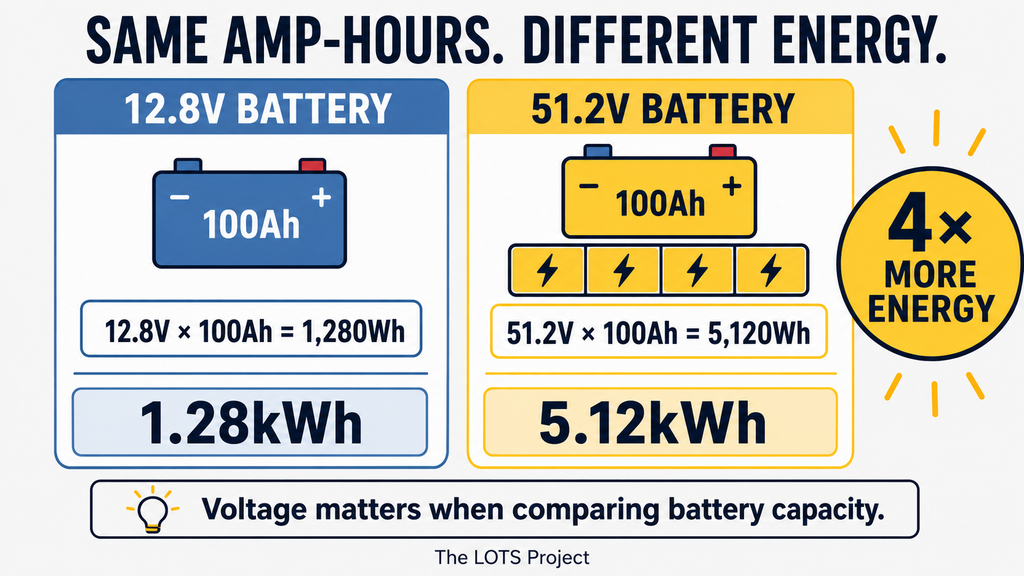
Consider a 12.8-volt, 100Ah lithium battery:
12.8 volts × 100 amp-hours = 1,280 watt-hours
That battery contains approximately 1.28 kilowatt-hours of nominal energy.
Now consider a common 48-volt-class lithium battery. Many of these batteries have a nominal voltage of 51.2 volts:
51.2 volts × 100 amp-hours = 5,120 watt-hours
That equals 5.12 kilowatt-hours of nominal energy.
Both batteries are rated at 100Ah, but the 51.2-volt battery stores approximately four times as much energy.
That’s why I find it easier to compare batteries using watt-hours or kilowatt-hours instead of amp-hours alone. Ultimately, I want to know how much energy is available when the sun isn’t shining.
Remember:
Volts × Amp-hours = Watt-hours
The calculated number is nominal storage capacity. Actual usable energy can be lower because of battery-management limits, inverter losses, system settings, temperature and other real-world factors.
Generation, Storage and Loads Must Work Together
A solar system has three major parts that must remain in balance:
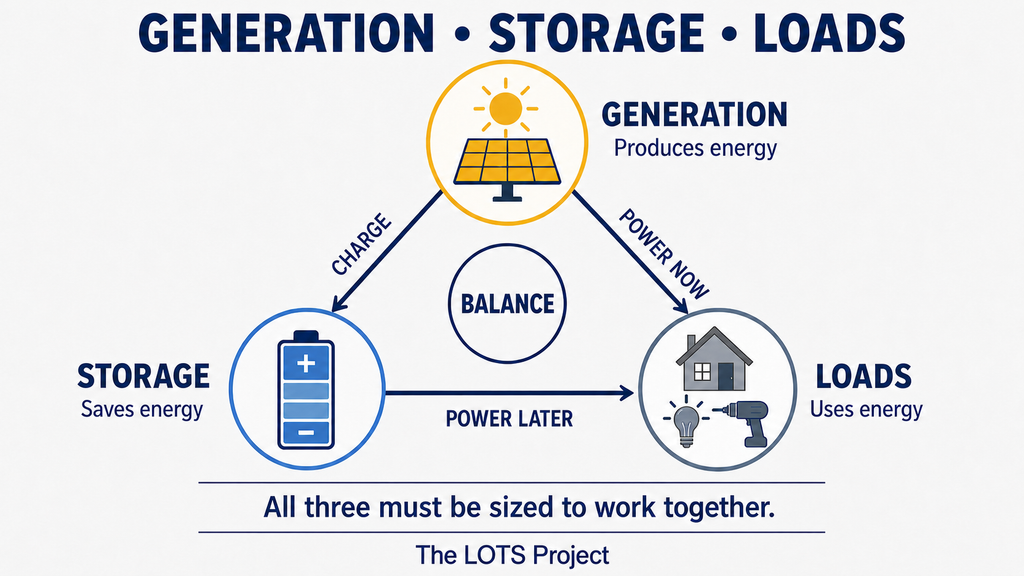
- Generation: The solar panels, generator or other sources producing energy.
- Storage: The battery bank holding energy for later use.
- Loads: Everything the system needs to power.
The conventional design process starts by calculating all the loads. You estimate daily energy consumption, size the battery bank around those loads and then size the solar array to recharge the batteries and supply daytime demand.
That is an excellent approach when starting with a blank sheet of paper—and enough money and space to build whatever the calculations recommend.
Real projects don’t always work that way.
When I designed the solar system for my RV, roof space was one of my largest limitations. I could only fit so many panels. Battery space and battery weight also limited what I could install.
My current system has a different limitation. I found a good deal on a large group of used solar panels, so I’m beginning with the panels I already have. Once I determine which panels survived transportation and how they perform, I’ll know the amount of potential solar generation available.
From there, I can make decisions about:
- How much battery storage makes sense
- What loads I can realistically operate
- Which loads should run during daylight
- How much overnight reserve I want
- How much poor weather the batteries should cover
- When the generator should be used
Your primary constraint might be money, roof space, battery weight, available land, existing equipment or a good deal you found on used panels.
There isn’t one perfect design process for every situation. The goal is to understand the trade-offs well enough to build a system that works within your actual limitations.
Common Beginner Mistakes
Before moving forward, watch out for these common mistakes:
Comparing Batteries Using Amp-Hours Alone
A 100Ah battery at 12.8 volts does not store the same amount of energy as a 100Ah battery at 51.2 volts. Convert both to watt-hours or kilowatt-hours before comparing them.
Treating Panel Wattage as All-Day Production
A 400-watt panel doesn’t produce 400 watts every hour of the day. Its rating represents potential output under specific conditions.
Confusing Kilowatts With Kilowatt-Hours
Kilowatts measure power. Kilowatt-hours measure energy produced or consumed over time.
Sizing One Part Without Considering the Others
A large solar array doesn’t help much if you can’t use or store its production. A massive battery bank won’t help if your panels can’t recharge it. Generation, storage and loads must be considered together.
The Foundation for Everything That Comes Next
These basic measurements will appear throughout the entire solar project:
- Volts and amps describe what is happening electrically.
- Watts describe how much power is being produced or consumed at a particular moment.
- Watt-hours and kilowatt-hours describe energy over time.
- Amp-hours describe battery capacity, but only mean something useful when paired with voltage.
You don’t need to memorize a pile of electrical theory. You need to understand the numbers well enough to recognize what the specifications mean and how one component affects another.
Next, we’re going to examine the label on the back of a solar panel. We’ll break down terms such as Voc, Vmp, Isc and Imp, explain which numbers matter most, and eventually use them to determine how panels can be connected without damaging the equipment.
Next lesson: How to Read a Solar Panel Label




One Comment